The transition from stateless language model completions to autonomous agent loops marks the most consequential architectural shift in software engineering since the advent of microservices. While raw frontier models provide raw semantic reasoning, an agent transforms that reasoning into goal-driven, deterministic real-world outcomes.
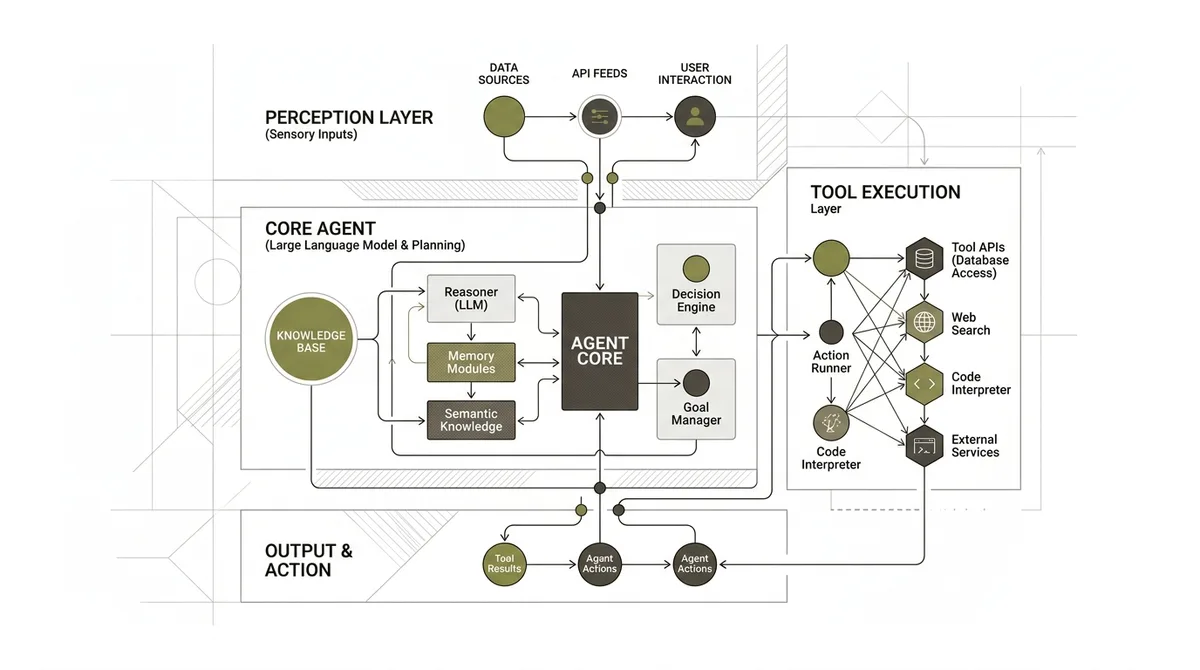
To engineer systems that can write software, orchestrate cloud infrastructure, or debug complex distributed errors, we must build around three fundamental architectural pillars: the Perception Layer, the Core Decision Engine, and the Tool Execution Pipeline.
Beyond the ReAct Loop: Modern Agent Control Flow
The classic ReAct (Reason + Act) loop introduced an elementary pattern: think, act, observe. While groundbreaking in early experiments, production-grade agentic systems quickly expose its limitations: infinite loops on unanticipated errors, context bloat, and compounding hallucinations across multi-step execution.
Modern production agents replace naive ReAct loops with structured state machines:
- Goal Decomposition & Planning: Before taking an action, the agent decomposes ambiguous user intent into a dependency graph of discrete verification-gated tasks.
- Context Budgets & Sliding Windows: Rather than feeding raw execution logs back into the model, a dedicated context manager prunes extraneous tool outputs and summarizes intermediate checkpoints.
- Execution Waves & Parallel Tooling: Independent steps execute asynchronously across parallel worker threads, synchronizing only at critical verification barriers.
interface AgentExecutionNode {
  taskId: string;
  intent: string;
  dependencies: string[];
  toolCalls: ToolInvocation[];
  verificationCriteria: string[];
  status: 'pending' | 'running' | 'verified' | 'failed';
}
The Three Layers of Agent Memory
An autonomous agent without durable memory is trapped in a permanent state of amnesia. Production systems must distinguish between three distinct memory tiers:
- Working Memory (Episodic): The active context window containing recent instructions, tool results, and the active scratchpad.
- Semantic Memory (Knowledge Graphs): Vector embeddings and structured entity relationships extracted from past sessions, allowing the agent to recall repository architectural patterns.
- Procedural Memory (Tool Schemas & Skills): Dynamic discovery of system capabilities. Instead of stuffing every possible API into the system prompt, modular skills load on demand based on task taxonomy.
“The true measure of an autonomous agent is not how fast it generates code, but how reliably it notices its own failures and self-corrects before human intervention.”
The weakest link in early agent implementations was tool hallucination—agents attempting to invoke nonexistent functions or corrupting JSON parameters. The emergence of open protocols like WebMCP (Web Model Context Protocol) provides standardized, bidirectional communication contracts between language models and runtime environments.
By enforcing strict JSON Schema validation and sandboxed process isolation, the agent operates with deterministic guarantees:
- Automatic schema synthesis from typed endpoints
- Non-blocking async execution with reactive wakeup signals
- Resilient recovery handlers when external dependencies fail
The future of software development belongs to engineers who understand how to design and govern these autonomous loops. By treating agents as distributed systems with clear observability, structured memory, and rigorous evaluation benchmarks, we unlock capabilities that transcend simple autocomplete into true cognitive leverage.