For the past two years, the conventional wisdom in machine learning engineering has been simple: real AI happens in cloud data centers over high-bandwidth H100 clusters, while local developer machines are merely thin clients issuing HTTP requests.
That paradigm is dissolving rapidly. The convergence of ultra-efficient open weights (DeepSeek-V3, Llama 3.3, Mistral Large), advanced quantization algorithms (AWQ, EXL2, GGUF), and unified memory architectures has made running frontier-grade models on local developer machines not just feasible, but surprisingly cost-effective.
The Memory Bandwidth Bottleneck
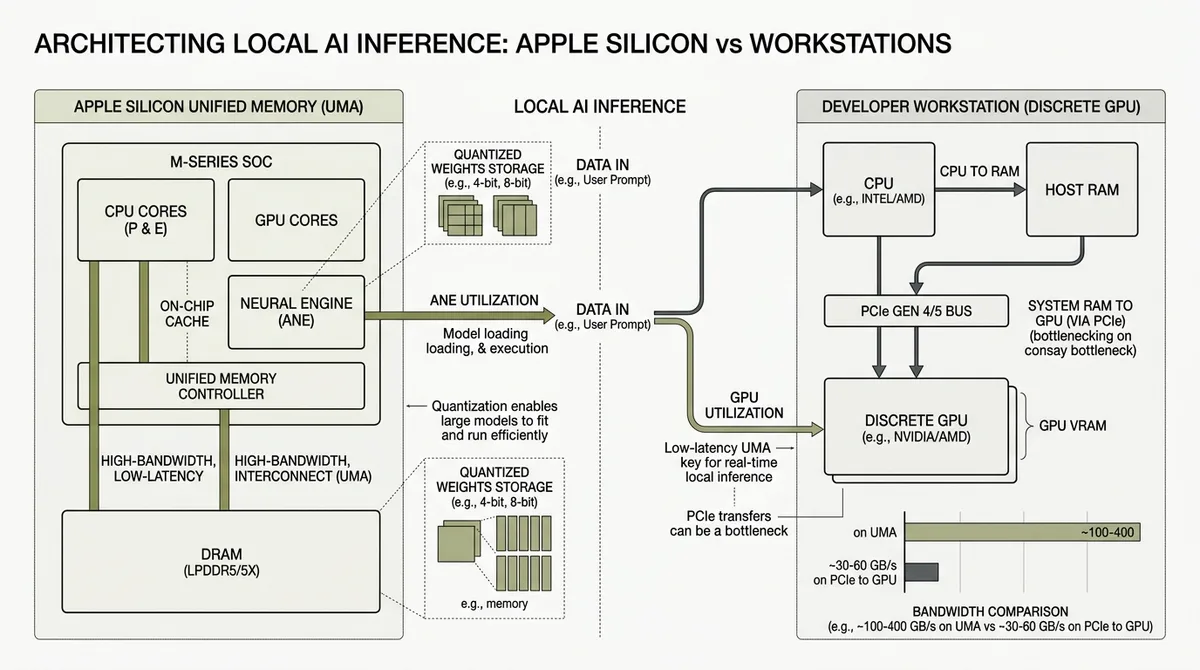
In LLM text generation, computation is overwhelmingly memory-bandwidth bound during token generation (decoding phase). For each token generated, the model must read all its billions of parameters from RAM into compute registers.
Consider running an unquantized 70-billion parameter model in 16-bit float:
- Memory required: $70 \times 2 = 140\text{ GB}$
- On a discrete workstation GPU with PCIe Gen 4/5 bus, transferring weights across the system RAM bottleneck caps throughput at 15–30 GB/s.
- On Apple Silicon with Unified Memory Architecture (UMA), the CPU, GPU, and Neural Engine share an ultra-wide memory bus exceeding 400–800 GB/s with zero PCIe copies.
# Running high-throughput local inference via llama.cpp server
llama-server \
  --model DeepSeek-Coder-V2-Lite-Q4_K_M.gguf \
  --ctx-size 65536 \
  --n-gpu-layers 99 \
  --threads 12 \
  --cont-batching \
  --port 8080
Quantization: Slicing Weights Without Slicing Smarts
The secret weapon of local AI engineering is weight quantization. Modern quantization techniques like AWQ (Activation-aware Weight Quantization) and K-quants protect salient weights while compressing non-critical parameters down to 4 or 3 bits per weight:
| Model & Quant |
Precision |
RAM Footprint |
Tokens / Sec (M3 Max) |
Reasoning Score (HumanEval) |
| Llama-3.3-70B-FP16 |
16-bit |
~144 GB |
— (Exceeds 128GB) |
82.4% |
| Llama-3.3-70B-Q4_K_M |
4.5-bit |
~43 GB |
18.2 t/s |
81.8% |
| DeepSeek-Coder-Q5_K |
5.1-bit |
~24 GB |
34.5 t/s |
83.1% |
| Qwen-2.5-32B-Q4_K_M |
4.5-bit |
~19 GB |
42.0 t/s |
84.0% |
Notice the astonishing degradation curve: moving from uncompressed FP16 down to a 4-bit quant reduces RAM requirements by over 68% while preserving more than 99% of benchmark coding reasoning capability.
Zero Latency, Total Privacy, Zero API Bills
Why do top engineering organizations invest in local developer inference stacks?
- Air-Gapped IP Protection: Proprietary codebases, internal customer records, and sensitive security credentials never leave the engineer’s physical device.
- Deterministic Offline Availability: Engineers can code, refactor, and run multi-agent test pipelines on airplanes, trains, or during cloud outages without connection timeouts.
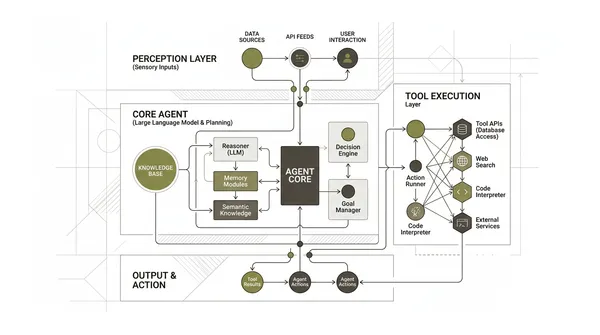
- Uncapped Experimentation: Running an autonomous agent with 5,000 tool iterations locally costs exactly zero dollars in API bills, allowing developers to test aggressive loops without anxiety.
By pairing local inference runtimes with standard OpenAI-compatible server interfaces, developers can build agents that run locally by default and seamlessly burst to cloud clusters only when extreme reasoning compute is strictly required.