Before the Model Context Protocol (MCP), every AI framework—from LangChain to custom internal agent harnesses—invented its own ad-hoc mechanism for exposing databases, file systems, and API endpoints to language models. The result was brittle plumbing, duplicated boilerplate, and immense security exposure.
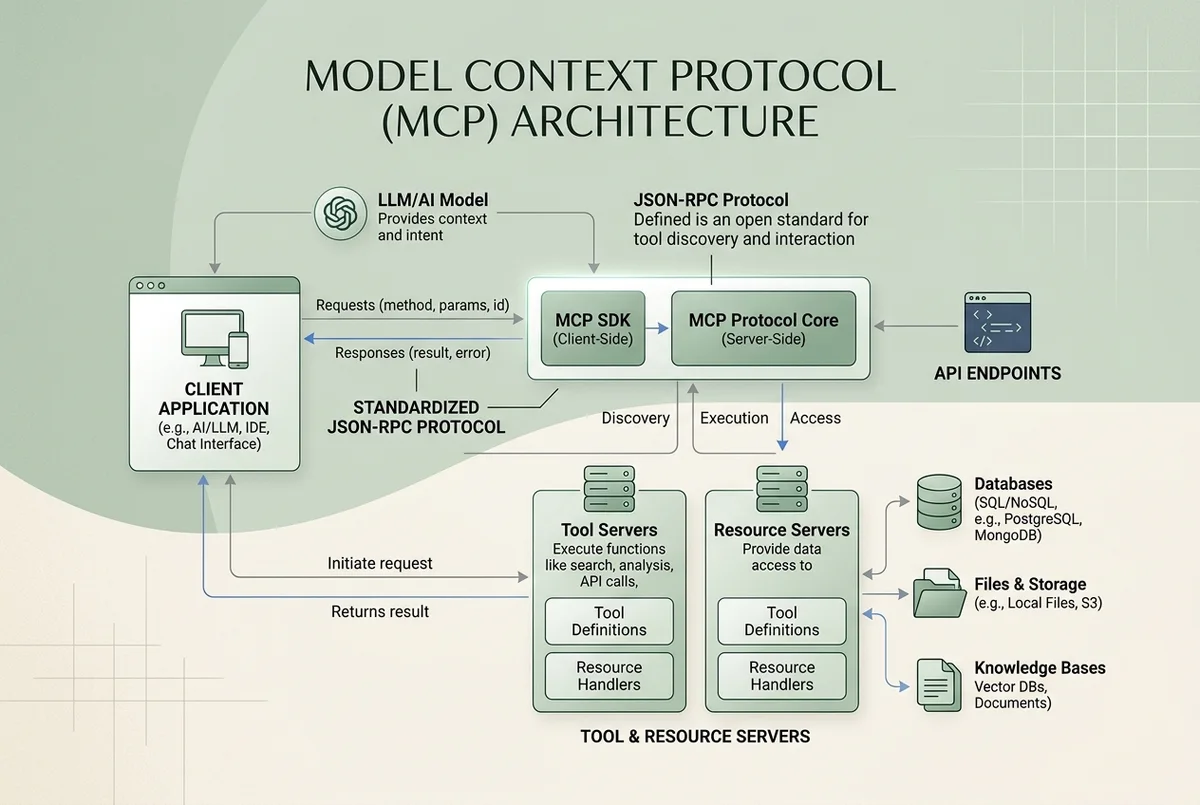
MCP standardizes the interface between AI host applications (like Claude Desktop, Cursor, or autonomous CLI runners) and external context providers. Instead of hardcoding tools into system prompts, applications dynamically discover and execute tools through a strict JSON-RPC 2.0 contract.
The Three Core Abstractions of MCP
The protocol divides context exchange into three orthogonal primitives:
- Resources: Read-only data representations similar to REST GET endpoints (e.g., file contents, schema definitions, system logs).
- Prompts: Reusable prompt templates and workflows exposed by the server that can be surfaced directly to the user or orchestrator.
- Tools: Executable functions that allow models to invoke actions in the runtime environment (e.g., executing SQL queries, querying git history, dispatching HTTP requests).
import { Server } from "@modelcontextprotocol/sdk/server/index.js";
import { StdioServerTransport } from "@modelcontextprotocol/sdk/server/stdio.js";
import { CallToolRequestSchema, ListToolsRequestSchema } from "@modelcontextprotocol/sdk/types.js";

const server = new Server({
  name: "tubesave-media-tools",
  version: "1.0.0",
}, {
  capabilities: { tools: {} },
});

server.setRequestHandler(ListToolsRequestSchema, async () => ({
  tools: [{
    name: "inspect_media_metadata",
    description: "Extract codecs, resolution, bitrate, and audio streams for a media URL",
    inputSchema: {
      type: "object",
      properties: {
        url: { type: "string", description: "Target media URL" },
      },
      required: ["url"],
    },
  }],
}));
When an autonomous agent has tool access, security cannot be an afterthought. Running MCP servers in production requires strict defense-in-depth:
- Process Isolation: MCP servers communicate over
stdio or Server-Sent Events (SSE). They run with restricted process privileges, limiting filesystem visibility to explicit workspace mount points.
- Human-in-the-Loop Validation: Sensitive actions (e.g., database writes or external webhooks) declare interactive permission prompts before execution proceeds.
- Deterministic Schema Verification: Incoming tool arguments are validated against strict Zod or JSONSchema validators before passing parameters to shell execution.
{
  "jsonrpc": "2.0",
  "id": 42,
  "method": "tools/call",
  "params": {
    "name": "inspect_media_metadata",
    "arguments": {
      "url": "https://example.com/video.mp4"
    }
  }
}
Why MCP Is Winning Developer Mindshare
Standardization unlocks an ecosystem of composable micro-agents. When an engineering team builds an MCP server for their Postgres database or media transcoding queue, that server instantly works across Cursor, Claude, local agent scripts, and custom internal dashboards without modifying a single line of host code.
By separating model intelligence from tool execution protocols, MCP brings true modularity to the agentic stack.