The explosion of rich media on the web—from YouTube tutorials and lecture recordings to podcast feeds and raw screencasts—has outpaced traditional text-only data processing. Transforming hours of asynchronous video into indexed, semantically queryable knowledge requires a specialized pipeline that handles both temporal visual frames and streaming audio waveforms.
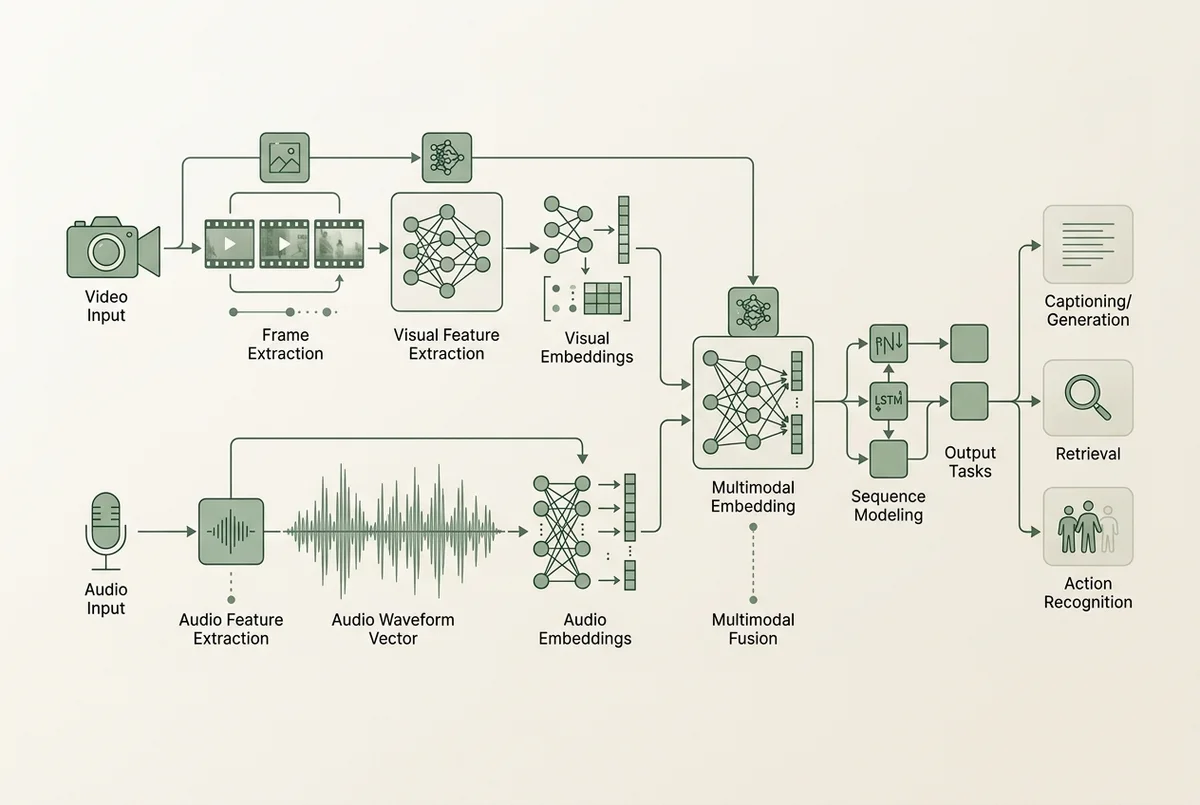
Building this infrastructure at production scale involves solving three major engineering bottlenecks: asynchronous ffmpeg demuxing, GPU-accelerated audio transcription with speaker diarization, and multimodal joint-embedding alignment.
1. Demuxing and Chunking Without Memory Bloat
Naively buffering full video files into memory will instantly crash containerized workers. When processing a 4K 60-minute stream, we demux audio and video tracks independently into chunked segments using low-overhead ffmpeg child processes.
# Extract high-efficiency 16kHz mono audio stream for Whisper
ffmpeg -i input_video.mp4 -vn -acodec pcm_s16le -ar 16000 -ac 1 audio_mono.wav

# Sample key visual frames every 2 seconds with scene-change heuristics
ffmpeg -i input_video.mp4 -vf "select='gt(scene,0.3)+isnan(prev_selected_t)+gte(t-prev_selected_t,2)',scale=768:-1" -vsync vfr frames/%04d.jpg
By decoupling the audio track from video keyframes immediately upon ingestion, we dispatch audio directly to batched transcription workers while visual frames run through batch CLIP/SigLIP inference in parallel.
2. Diarization and Faster-Whisper Batching
Raw speech-to-text without timestamp alignment or speaker identification is largely unusable for agentic reasoning. We use faster-whisper (backed by CTranslate2) combined with PyAnnote audio segmentation to achieve 4x real-time transcription speeds on a single RTX 4090 or T4 GPU.
from faster_whisper import WhisperModel

model = WhisperModel("large-v3", device="cuda", compute_type="float16")

segments, info = model.transcribe(
    "audio_mono.wav",
    beam_size=5,
    vad_filter=True,
    vad_parameters=dict(min_silence_duration_ms=500),
    word_timestamps=True
)

aligned_transcripts = []
for segment in segments:
    aligned_transcripts.append({
        "start": segment.start,
        "end": segment.end,
        "text": segment.text.strip(),
        "words": [{"word": w.word, "start": w.start, "end": w.end} for w in segment.words]
    })
3. Joint Multimodal Embeddings & Temporal Indexing
To allow natural language queries like “show me the moment the engineer discusses the memory leak” to land on the exact timestamp, we align visual frame embeddings with the transcribed text tokens:
- Visual Vectors: SigLIP-SO400M computes a 1152-dimensional dense vector for each sampled keyframe.
- Transcript Vectors: Text-embedding-3-large computes semantic vectors over sliding 30-second timestamp windows.
- Hybrid Storage: Stored in Qdrant or Milvus with a unified payload containing
{ video_id, timestamp_start, timestamp_end, frame_url, transcript_chunk }.
When a user or autonomous agent queries the system, hybrid retrieval fuses the dense vector cosine similarity with BM25 lexical matching.
The Production Payoff
By treating multimodal media ingestion as a resilient, decoupled streaming pipeline, platforms like TubeSave can index hours of high-definition video in minutes. Agents can pinpoint exact frame citations, generate chapter summaries with millisecond precision, and unlock conversational search across terabytes of media content.