When software engineers first experiment with AI agents, their instinct is almost always to create a monolithic “super-agent”—a single prompt loaded with twenty different tools, tasked with understanding the entire application stack simultaneously.
Inevitably, these monolithic agents buckle under cognitive load. Context windows fill with irrelevant tool definitions, attention degrades across thousands of tokens, and conflicting tool outputs cause circular decision loops.
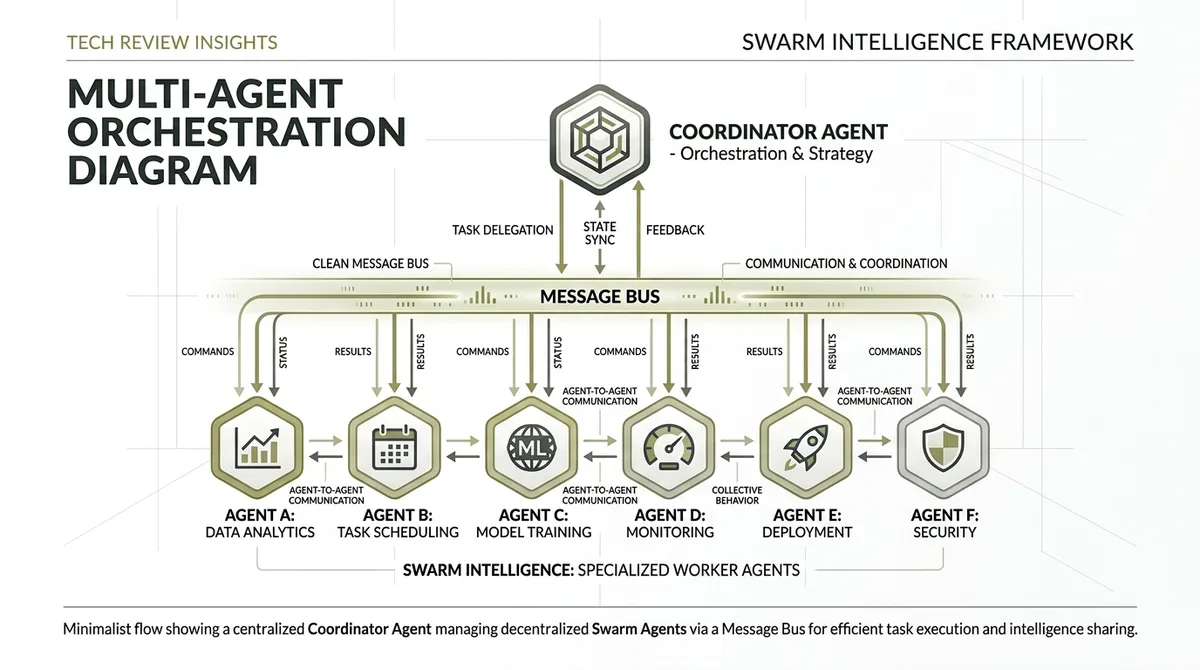
The solution, proven across decades of distributed systems engineering, is specialization: decomposing complex workflows into a swarm of focused, autonomous subagents coordinated through a resilient message bus.
The Coordinator-Worker Topology
In a production multi-agent system, the primary interface does not directly execute low-level database queries or parse AST trees. Instead, it operates as a Coordinator Agent:
- Strategic Planning: Parsing the top-level user goal and establishing acceptance criteria.
- Dynamic Task Delegation: Spawning purpose-built worker agents (e.g., Code Mapper, Test Runner, Security Auditor).
- State Synchronization & Conflict Resolution: Merging worker findings into a unified architectural model and adjudicating contradictions.
// Coordinator dispatch pattern
const coordinator = new CoordinatorAgent({
  workers: {
    architect: new SystemDesignAgent(),
    reviewer: new SecurityAuditAgent(),
    executor: new TestDrivenCodeAgent(),
  },
  communicationProtocol: 'WebMCP',
  maxParallelWorkers: 4,
});

const executionRun = await coordinator.orchestrate({
  mission: 'Refactor auth middleware to zero-trust session tokens',
  qualityGate: 'UAT-passed',
});
Eliminating Cross-Agent Hallucinations
When multiple agents interact, compounding errors are the primary failure mode. If Agent A makes a false assumption and passes it to Agent B, Agent B will optimize around that hallucination with mathematical precision.
To safeguard system integrity, modern multi-agent frameworks enforce strict architectural boundaries:
- Ephemeral Sandboxes: Each subagent executes in an isolated environment with its own bounded context window, preventing context contamination from sibling runs.
- Explicit Artifact Hand-offs: Agents communicate through structured files and typed schemas rather than raw conversational dialog.
- Independent Verification Gates: A specialized Critic Agent with a separate system prompt validates outputs against unit tests before the Coordinator marks any milestone as complete.
“A well-architected swarm of small, specialized 7B/14B parameter models with strict contracts consistently outperforms a single monolithic 400B model forced to do everything.”
The Emerging WebMCP Standard
Protocols like WebMCP (Web Model Context Protocol) provide the missing coordination layer for multi-agent systems. By establishing typed client-server abstractions for AI agents, WebMCP allows agents running across different languages (Python, TypeScript, Rust) or separate machines to discover tools dynamically, stream telemetry events, and coordinate tasks without vendor lock-in.
As AI systems evolve from single assistants into coordinated engineering teams, mastering multi-agent orchestration becomes the quintessential architecture skill for the next decade of software engineering.