Every engineer who has deployed a language model to production has experienced the dreaded 2:00 AM incident: a prompt that worked flawlessly across five hundred tests suddenly outputs Markdown wrapped in conversational pleasantries, breaking the downstream JSON parser.
Relying on post-hoc regex parsing or hoping that models “strictly output only valid JSON” is fundamentally incompatible with enterprise service-level agreements. To achieve 99.9% reliability, production LLM pipelines must shift from prompt pleading to mathematical constraints: grammar-guided decoding and continuous evaluation suites.
Constrained Decoding: Enforcing Grammar at the Logit Level
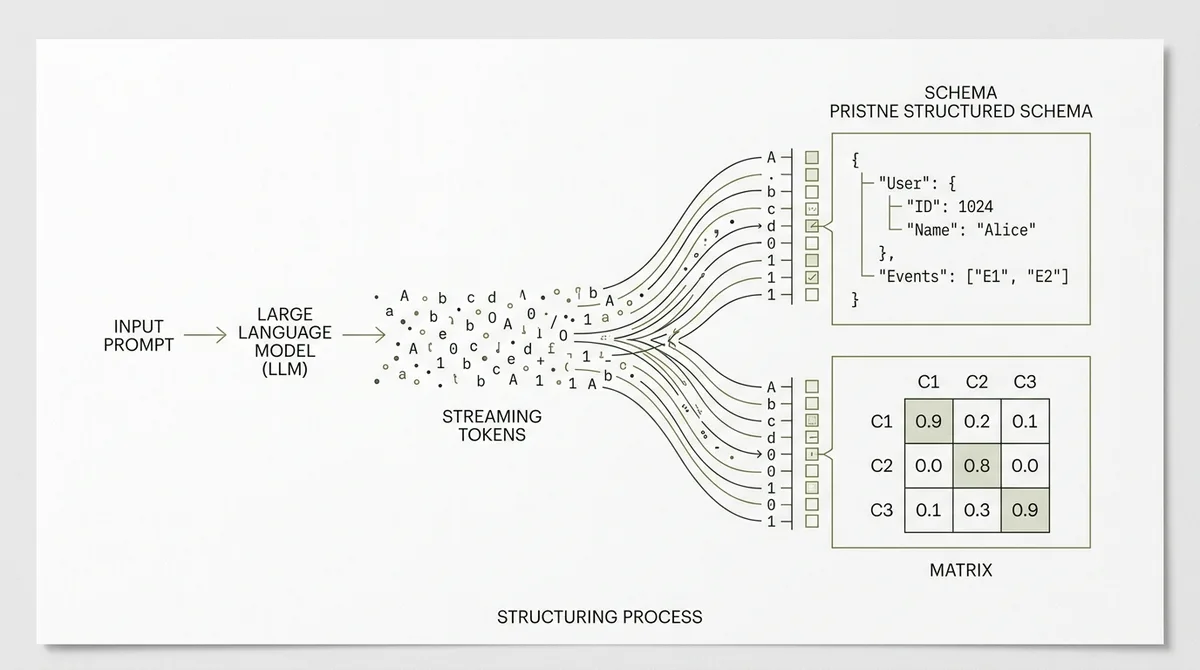
The breakthrough in structured generation comes not from bigger prompts, but from constrained logit masking during token sampling.
When you provide a JSON Schema or Pydantic model to a modern inference runtime, the engine builds a deterministic Context-Free Grammar (CFG) or regular expression state machine:
- At each token step, the runtime calculates which token IDs are syntactically valid according to the grammar.
- Invalid tokens receive a logit mask of negative infinity ($-\infty$).
- The model literally cannot produce a syntax error, invalid bracket, or unescaped quote.
import { z } from 'zod';

export const AgentPlanSchema = z.object({
  version: z.literal('2.0'),
  summary: z.string().min(10),
  riskLevel: z.enum(['low', 'medium', 'high', 'critical']),
  actions: z.array(z.object({
    order: z.number().int(),
    tool: z.string(),
    parameters: z.record(z.unknown()),
    rollbackProcedure: z.string().optional(),
  })),
});

export type AgentPlan = z.infer<typeof AgentPlanSchema>;
The Three Pillars of a Production Eval Harness
Guaranteeing syntactic correctness is only half the battle; the output must also be semantically accurate. Moving fast with LLMs requires an automated evaluation pipeline that runs on every git pull request.
- Deterministic Unit Tests: Assertions verifying hard constraints—schema adherence, non-empty fields, forbidden tokens, and execution bounds.
- Model-Graded Evals (LLM-as-a-Judge): Using frontier reasoning models running structured rubric rubrics to evaluate qualitative criteria such as tone, completeness, and reasoning fidelity.
- Golden Reference Benchmarks: Curated test suites of known edge cases with ground-truth expected outcomes, tracking accuracy drift across model version updates.
“If you do not measure model drift with programmatic evals, your users are your eval pipeline.”
Production Latency and Throughput Gains
Beyond eliminating parsing errors, structured outputs dramatically reduce overall system latency. By avoiding rambling disclaimers (“Sure! Here is the JSON you requested:”), token count drops by 30% to 60%. Because generation cost and time are strictly linear with generated token volume, constrained schemas deliver immediate operational savings.
In high-throughput architectures, pairing structured outputs with streaming chunk parsing allows user interfaces to render typed UI components as the tokens arrive over WebSocket streams.