When prototyping an AI application with a few dozen test queries, token costs appear negligible—a couple of pennies per session. But as traffic scales into hundreds of thousands of daily active users executing multi-turn agent conversations, token economics quickly become the single largest line item on your cloud infrastructure invoice.
At scale, naive API integration patterns can destroy software margins. Fortunately, modern inference runtimes and architectural strategies provide engineers with powerful levers to reduce token consumption and inference latency by up to 85% without sacrificing model intelligence.
1. Prompt Caching and KV-Cache Reuse
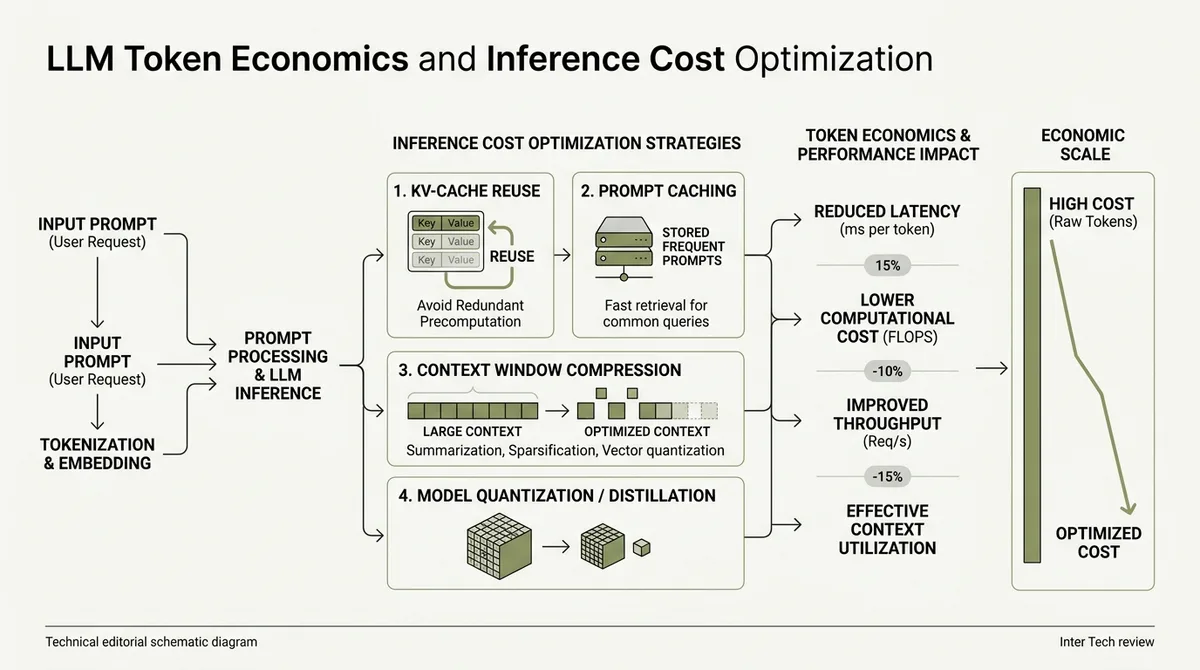
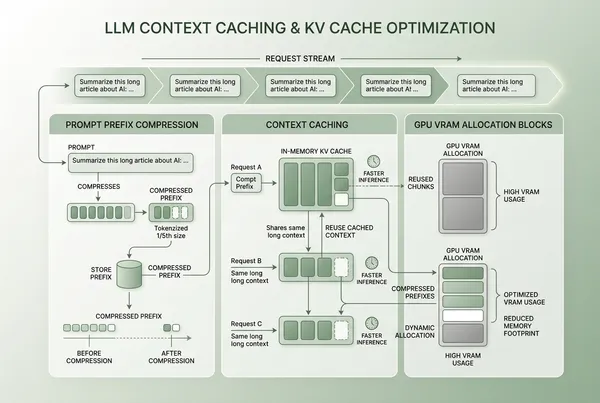
The single highest-ROI optimization available today is prompt caching. In typical chat or agent architectures, 80% to 90% of the input prompt consists of static context: system guidelines, repository documentation, API definitions, and few-shot examples.
Without caching, the model must recompute the Key-Value (KV) matrices for those identical tokens on every single generation step. With prompt caching:
- The inference engine checkpoints the computed KV-cache in GPU VRAM or fast flash storage.
- Subsequent calls sharing the same initial token prefix reuse the cached state directly.
- Caching typically delivers a 50% to 90% price discount on input tokens and cuts Time to First Token (TTFT) by up to 80%.
// Structuring prompts for maximum KV-cache hits
const systemPrompt = {
  // Static prefix placed FIRST to maximize cache hit rate
  role: 'system',
  content: [
    { type: 'text', text: CORE_SYSTEM_CONTRACT },
    { type: 'text', text: REPOSITORY_DOCUMENTATION },
    { type: 'text', text: TOOL_SCHEMAS, cache_control: { type: 'ephemeral' } },
  ],
};
2. Dynamic Context Window Compression
More context is not always better context. As context length grows into tens of thousands of tokens, models suffer from the “lost in the middle” degradation phenomenon, where attention to critical nuances fades.
High-efficiency systems implement active context budgeting:
- Token Slicing: Truncating verbose command line outputs and test tracebacks to only the relevant failure stack frames.
- Semantic Chunk Compaction: Replacing raw multi-turn conversation logs with compact episodic summaries before passing context into downstream subagents.
- Sparse Retrieval: Using hybrid vector + BM25 keyword search to retrieve only the 3 most relevant code snippets instead of dumping whole directories into prompts.
“Every token you do not send to the model is a token you do not pay for, do not wait for, and cannot hallucinate on.”
3. Tiered Model Cascading
Not every task requires the maximum reasoning horsepower of a frontier model. Routing simple tasks (e.g., entity extraction, sentiment classification, format cleanup) to a small, fast 8B model while reserving flagship frontier models exclusively for multi-step architectural planning can reduce average request cost by more than 75%.
By combining structured prompt caching, intelligent context compression, and tiered model routing, engineering teams transform generative AI from an unpredictable cost center into an economically scalable competitive moat.